
The Rutherford County Circuit Court
Circuit Court is Tennessee's general-jurisdiction trial court. In Rutherford County, it sits at the Rutherford County Judicial Center on West Lytle Street in Murfreesboro. The court handles a broad range of matters: civil suits, felony criminal cases, and appeals from lower courts such as General Sessions, Juvenile Court, and Municipal Court. When a General Sessions case is appealed, it moves up to Circuit Court for a de novo hearing, meaning the case is heard fresh rather than reviewed on the lower-court record.
The Circuit Court is divided into two main tracks: Circuit Civil and Circuit Criminal. Each has its own clerk line within the Circuit Court Clerk's office, and each runs a separate docket. Civil matters range from personal-injury claims and contract disputes to domestic cases not assigned to Chancery. Criminal matters cover felony charges and appeals from misdemeanor convictions in the lower courts. Both tracks sit in the Judicial Center, which opened in 2018 to serve Rutherford County's growing population.
The Tennessee Administrative Office of the Courts explains that Circuit Court, along with Chancery Court, is a court of general and equity jurisdiction at the trial level. Some Tennessee counties also have separate Criminal Courts created by the legislature, but Rutherford County's criminal trial work is handled through Circuit Court rather than a standalone Criminal Court. That means both felony trial matters and criminal appeals feed through the same Circuit Court structure.
The Tennessee AOC page on Circuit, Criminal, and Chancery Courts sets out the statewide framework for how these courts operate across all 95 Tennessee counties.
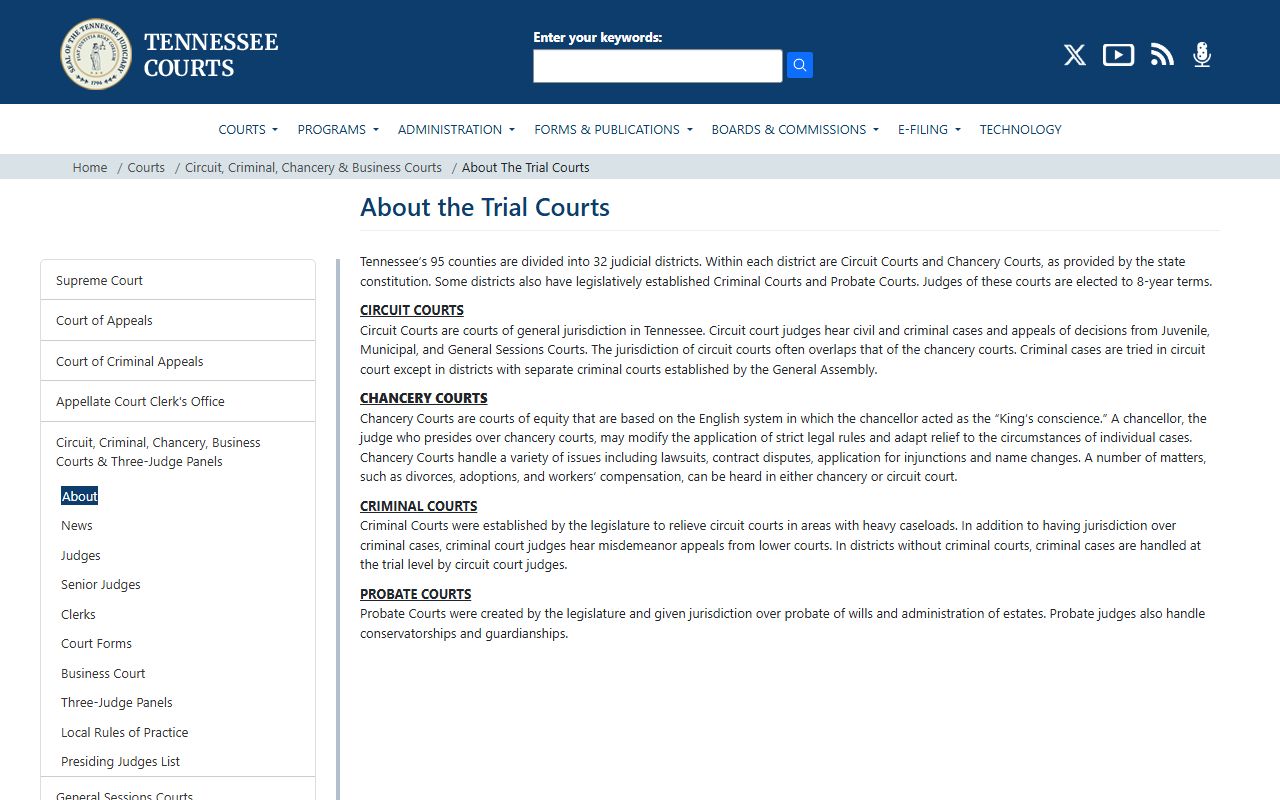
The AOC page describes Circuit Court jurisdiction in detail and is useful when trying to understand the difference between what Circuit Court handles versus Chancery and General Sessions.
The 16th Judicial District
Tennessee divides its 95 counties into judicial districts for trial court administration. Rutherford County and Cannon County together make up the 16th Judicial District. Circuit Court judges in this district serve both counties, and the District Attorney General and Public Defender each represent both Cannon and Rutherford in their respective roles. The district structure ties the two counties together for purposes of court assignments, grand jury cycles, and judicial elections.
The District Attorney General for the 16th Judicial District is Jennings H. Jones. He is a career prosecutor who joined the District Attorney's Office in 1998, served as an Assistant District Attorney for 16 years, and ran for office in 2014. His stated goal is to seek justice in each case. The District Public Defender is Gerald L. Melton. He was born in Cannon County, earned his undergraduate degree from MTSU in 1978 and his JD from the University of Tennessee College of Law in December 1980, served as Assistant District Attorney from 1984 to 1989, and was then appointed Public Defender by Governor Ned Ray McWherter in 1989. He was elected in 1990 and has been re-elected in 1998, 2006, 2014, and 2022.
Contact information for both offices appears in the District Attorney and Public Defender section below. For Rutherford County criminal records, the Circuit Court Clerk handles Circuit Criminal filings and the related docket.
Circuit Court Jurisdiction in Rutherford County
Circuit Court handles both civil and criminal matters. On the civil side, it hears general civil cases including personal injury, contract, property disputes, and some family matters. It also hears civil appeals from General Sessions Court, where the case is retried from the start rather than just reviewed for legal error. Civil cases worth more than General Sessions' jurisdictional limit must be filed in Circuit Court from the beginning.
On the criminal side, Circuit Court is where felony cases go to trial after indictment or bound-over from General Sessions. It also handles criminal appeals from lower courts, including misdemeanor convictions in General Sessions. If you are tracking a felony charge from arrest through sentencing, the case will spend most of its time in Circuit Criminal. For appeals filed after a General Sessions criminal case, the Circuit Court clerk processes the appeal and the matter gets a new hearing before a Circuit Court judge. The court dockets page explains how to check Circuit Court hearing dates and term schedules using the county's calendar tools.
Appeals beyond the Circuit Court level go to the Tennessee Court of Criminal Appeals for criminal matters or the Tennessee Court of Appeals for civil matters, and then potentially to the Tennessee Supreme Court. That appellate path is described in the Appeals Path section below.
Chancery Court Jurisdiction
Chancery Court is a separate court that sits alongside Circuit Court in the Rutherford County Judicial Center. While Circuit Court is the general trial court, Chancery is the equity court and handles a distinct set of case types. In Rutherford County, Chancery handles divorce, adoption, paternity, legitimation, surrender, orders of protection, child support, conservatorships, guardianships, probate-related matters, real estate matters, partition suits, name changes, contract and debt actions, specific performance, trusts, contempt, minor settlements, and foreign judgments.
The Clerk and Master for Chancery Court is Adam T. Dodd. He is the principal administrative aide to the Chancellor and manages records, docket maintenance, revenue, court minutes, and official communications. He also serves as Special Master in hearing pendente lite divorce and paternity matters in both Chancery and Circuit Courts. Chancery Court records are kept separately from Circuit Court records, and the Chancery office is at Suite 5101 in the Judicial Center rather than Room 102 where the Circuit Court Clerk sits. For full details on equity filings and the Chancery docket, see the Chancery Court page.
General Sessions Court
General Sessions Court is a limited-jurisdiction court, meaning it does not handle the full range of civil and criminal matters that Circuit Court does. It sits below Circuit Court in the hierarchy and is the entry point for many civil disputes and criminal first appearances in Rutherford County. General Sessions is where most misdemeanor cases are heard and where preliminary hearings on felony charges take place before a case is bound over to the grand jury or dismissed.
On the civil side, General Sessions handles landlord-tenant detainer warrants, small claims, and other civil money matters within its statutory limit. On the criminal side, it handles misdemeanor charges from start to finish and the early stages of felony cases. If a felony defendant waives a preliminary hearing, the case moves straight to the Circuit Criminal docket after indictment. If the defendant requests a preliminary hearing, it happens in General Sessions before the case can be bound over. Judge Toby Gilley is identified as the General Sessions Civil judge on the official county page.
General Sessions Civil is reached at (615) 217-0069, and General Sessions Criminal is reached at (615) 898-7831. Both divisions sit in the Judicial Center at 116 W. Lytle St. Appeals from General Sessions go to Circuit Court, where the matter is heard fresh. The Tennessee AOC General Sessions Court page provides more detail on the statewide framework for these limited-jurisdiction courts.
Juvenile and Probate Structure
Juvenile Court in Rutherford County handles matters involving minors, including delinquency, dependency, neglect, abuse, and related child-welfare proceedings. Tennessee law makes juvenile records generally confidential under Tenn. Code Ann. section 37-1-153, so these records are not open to the public the way adult civil and criminal files are. The Juvenile Clerk's Office is part of the Circuit Court Clerk's office, but it maintains confidential records separate from the public circuit docket. The clerk line for Juvenile is (615) 898-7972. The Tennessee AOC juvenile court page explains the county-based juvenile jurisdiction structure across the state.
Probate in Rutherford County works through a local arrangement created by private act of the legislature. General Sessions Judges serve as Probate Judges under that private act. When a judge admits an estate to probate, the attorney then files the necessary documents with the County Clerk rather than with the Circuit Court Clerk. Lisa Duke Crowell, the County Clerk, handles conservatorships, guardianships, and probating estates and wills. Her main office is at 319 N. Maple St., Suite 121, Murfreesboro, TN 37130. Probate matters are public records and can be reviewed at the County Clerk's office. For full probate procedures and fees, see the Rutherford County probate records page.
Rutherford County Courts and Offices
The following table lists the courts and offices that handle filings in Rutherford County, along with their roles, addresses, and primary phone numbers. All of the court offices listed below sit in the Judicial Center at 116 West Lytle Street in Murfreesboro unless otherwise noted. Use the phone number for the specific division you need, since the clerk lines vary by court function.
| Court / Office | Role | Address | Phone |
|---|---|---|---|
| Circuit Court Clerk - Circuit Civil | Circuit civil filings, records, and civil docket support | 116 W. Lytle St., Room 102, Murfreesboro, TN 37130 | (615) 898-7820 |
| Circuit Court Clerk - Circuit Criminal | Circuit criminal filings, records, and criminal docket support | 116 W. Lytle St., Room 102, Murfreesboro, TN 37130 | (615) 898-7812 |
| General Sessions Civil Court | Noncriminal legal matters, landlord/tenant, small claims | 116 W. Lytle St., Murfreesboro, TN 37130 | (615) 217-0069 |
| General Sessions Criminal Court | Misdemeanor and preliminary criminal matters | 116 W. Lytle St., Murfreesboro, TN 37130 | (615) 898-7831 |
| Juvenile Clerk's Office | Juvenile court filings and records (confidential) | 116 W. Lytle St., Murfreesboro, TN 37130 | (615) 898-7972 |
| Chancery Court / Clerk and Master | Equity matters: divorce, adoption, paternity, orders of protection, conservatorships, guardianships, probate-related matters, name changes, trusts | 116 W. Lytle St., Suite 5101, Murfreesboro, TN 37130 | (615) 898-7860 |
| Probate Court | General Sessions Judges serve as Probate Judges by private act; County Clerk handles estate filings after admission | County Clerk, 319 N. Maple St., Suite 121, Murfreesboro, TN 37130 | (615) 898-7800 |
| District Attorney General, 16th Judicial District | State criminal prosecution for Cannon and Rutherford Counties | 320 West Main Street, Suite 100, Murfreesboro, TN 37130 | (615) 898-8008 |
| Public Defender, 16th Judicial District | Indigent criminal defense for Cannon and Rutherford Counties | Elrod Building, 118 North Church Street, Murfreesboro, TN 37130 | (615) 898-8020 |
The Circuit Court Clerk for all Circuit and General Sessions divisions is Melissa Harrell, an elected official serving a four-year term. For Circuit Court Clerk details including hours, fax numbers, and how to request records, see the dedicated clerk page. The collections office for outstanding court costs is reached at (615) 849-5737.
How a Case Moves Through the System
Understanding the path a case takes helps you know which court to contact and which records to look for. The flow below describes the typical path for a criminal case, which is the most common source of questions about the court system. Civil cases have a similar structure but start at different points depending on the dollar amount and subject matter.
Step 1: General Sessions Court - A criminal case usually begins in General Sessions. For a misdemeanor, the entire case may be heard and decided here. For a felony, General Sessions handles the first appearance, bond, and any preliminary hearing. If the defendant waives the preliminary hearing or is bound over after one, the case moves to Circuit Court after a grand jury indictment or presentment.
Step 2: Circuit Court - Circuit Court is where felony cases go to trial. Arraignment, pretrial motions, plea hearings, and the actual trial all happen in Circuit Criminal. Civil matters from outside General Sessions' jurisdictional range, and civil appeals from General Sessions, are heard in Circuit Civil. The Circuit Court Clerk maintains all filings and the official docket for both tracks. Case records searchable through the county's online portal include Circuit Court matters.
Step 3: Court of Appeals or Court of Criminal Appeals - After a final judgment in Circuit Court, a party who wants to appeal takes the case to the appropriate intermediate appellate court. Criminal appeals go to the Tennessee Court of Criminal Appeals. Civil appeals go to the Tennessee Court of Appeals. These are courts of review, not new trials; they look at whether legal error occurred in the lower court rather than hearing the facts fresh.
Step 4: Tennessee Supreme Court - The Tennessee Supreme Court is the court of last resort for state matters. Review is discretionary in most cases, meaning the court chooses which cases to accept. The Supreme Court also has administrative authority over the entire state judiciary and sets rules such as Tennessee Supreme Court Rule 34, which governs public access to court records.
For civil matters that begin in General Sessions, the path starts at General Sessions and appeals go to Circuit Court for a fresh trial. If that Circuit Court result is appealed, it then moves to the Tennessee Court of Appeals rather than back to General Sessions. The key point is that each step up the ladder is a different court with different rules, fees, and procedures.
Circuit Court vs General Sessions vs Chancery
People often need to know which court handles their type of case before they go to the Judicial Center. The table below compares the three main trial-level courts in Rutherford County so you can see at a glance where to file or which records to request.
| Feature | Circuit Court | General Sessions Court | Chancery Court |
|---|---|---|---|
| Type of court | General jurisdiction trial court | Limited jurisdiction court | Equity court |
| Civil matters | General civil, appeals from General Sessions | Landlord/tenant, small claims, civil warrants | Divorce, name changes, trusts, conservatorships, contract/equity matters |
| Criminal matters | Felony trials, criminal appeals from lower courts | Misdemeanors, felony preliminary hearings | None (civil/equity court) |
| Clerk | Circuit Court Clerk (Melissa Harrell) | Circuit Court Clerk (same office, different division) | Clerk and Master (Adam T. Dodd) |
| Primary phone | (615) 898-7820 civil / (615) 898-7812 criminal | (615) 217-0069 civil / (615) 898-7831 criminal | (615) 898-7860 |
| Appeal goes to | Court of Appeals or Court of Criminal Appeals | Circuit Court (de novo) | Court of Appeals |
| Online search | Available via county portal (Circuit Court filter) | Available via county portal (General Sessions filter) | Available via county portal (Clerk and Master filter) |
All three courts are located in the Judicial Center at 116 W. Lytle St. in Murfreesboro. All three are searchable through the free Rutherford County Online Court Records System at rutherford.tncrtinfo.com, which moved to a free search model on July 1, 2025, after the Circuit Court Clerk ended subscription logins. For equity matters handled by Chancery, the Chancery Court page has fuller detail on case types and how to request copies.
Federal Courts Covering Rutherford County
State court cases in Rutherford County go through the Circuit, Chancery, General Sessions, and appellate courts described above. Federal cases, which involve federal law, federal crimes, constitutional claims, civil rights, and certain civil matters between parties from different states, go to a separate federal court system. Rutherford County is within the U.S. District Court for the Middle District of Tennessee.
The U.S. District Court for the Middle District of Tennessee is the federal trial court for Rutherford County. Chief District Judge William L. Campbell, Jr. and Clerk of Court Lynda M. Hill lead the court. The main staffed Nashville courthouse is the Fred D. Thompson U.S. Courthouse and Federal Building at 719 Church Street, Nashville, TN 37203. The court also has locations in Columbia and Cookeville. State criminal records from Rutherford County are not in the federal district court system unless a case is removed to federal court, filed federally, or reviewed in a federal habeas or civil rights matter.
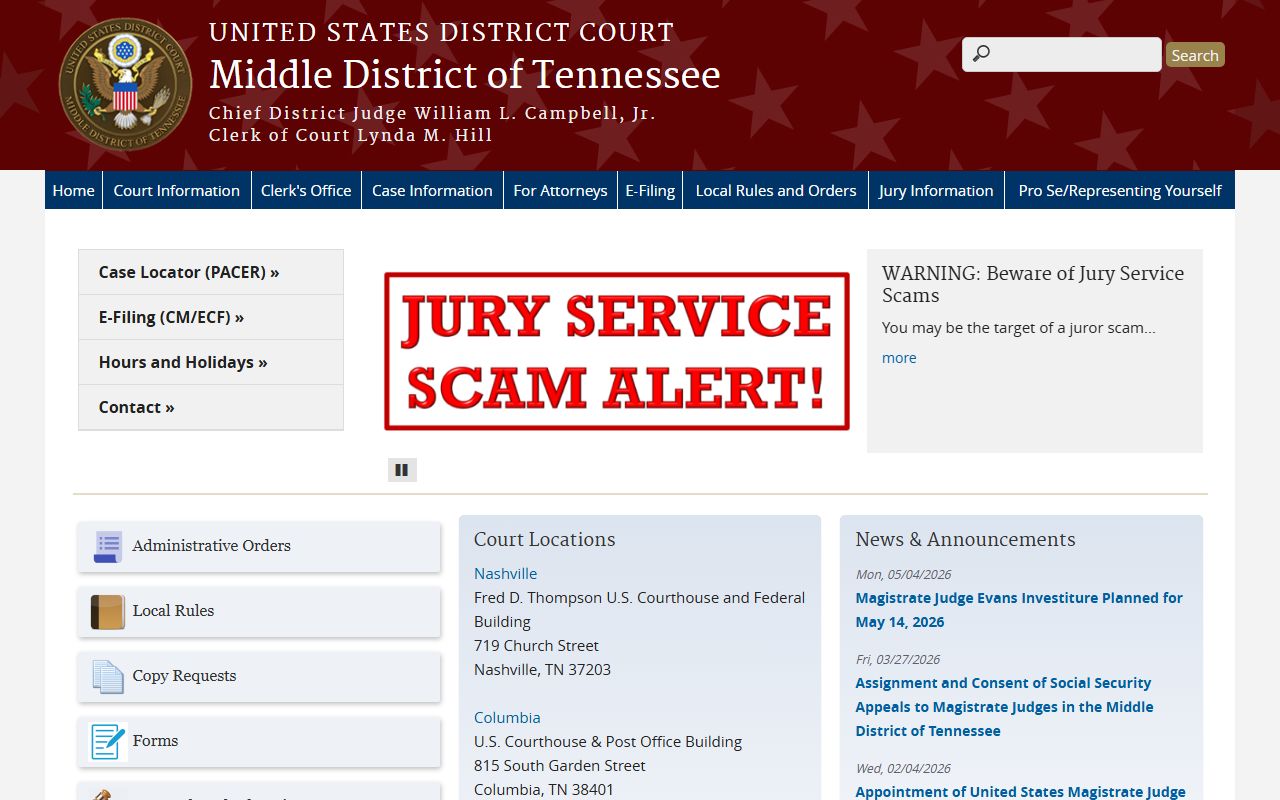
The Middle District handles federal crimes, civil rights claims, constitutional matters, federal-question civil cases, diversity civil cases, Social Security appeals, and prisoner civil rights filings among other case types.
Federal bankruptcy for Rutherford County is handled by the U.S. Bankruptcy Court for the Middle District of Tennessee. Chief Judge Randal S. Mashburn and Clerk Vanessa A. Lantin lead that court. Its Nashville location is 701 Broadway, Room 170, Nashville, TN 37203, reachable at (615) 736-5584. Clerk hours are Monday through Friday, 8:00 a.m. to 4:00 p.m.
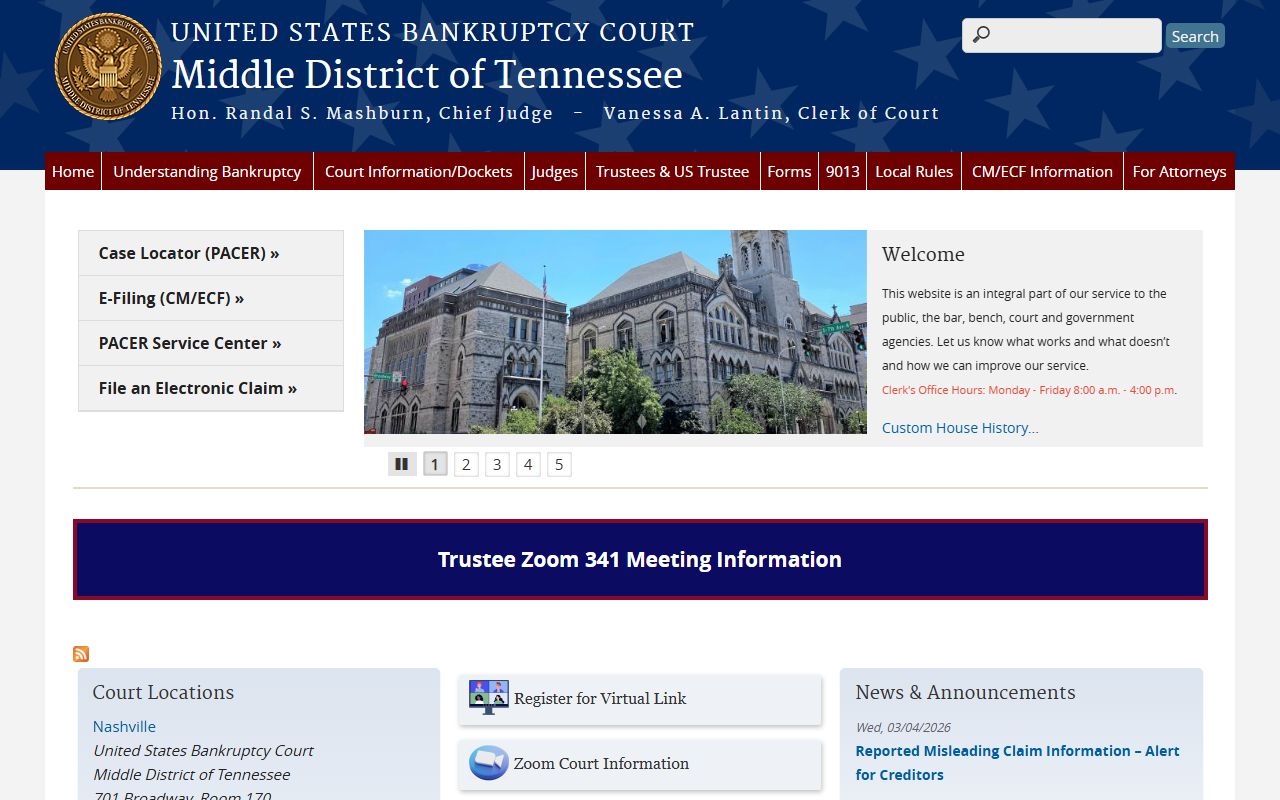
The bankruptcy court also has unstaffed offices in Columbia and Cookeville, but the Nashville location handles most filings for the Middle District. Attorneys file bankruptcy matters through the bankruptcy CM/ECF system.
That electronic filing system uses the same PACER login that the district court uses, so a single registration covers both.
Appeals from the Middle District of Tennessee go to the U.S. Court of Appeals for the Sixth Circuit, headquartered at the Potter Stewart U.S. Courthouse, 100 East Fifth Street, Cincinnati, Ohio 45202, phone (513) 564-7000. The Sixth Circuit covers Tennessee, Kentucky, Michigan, and Ohio.
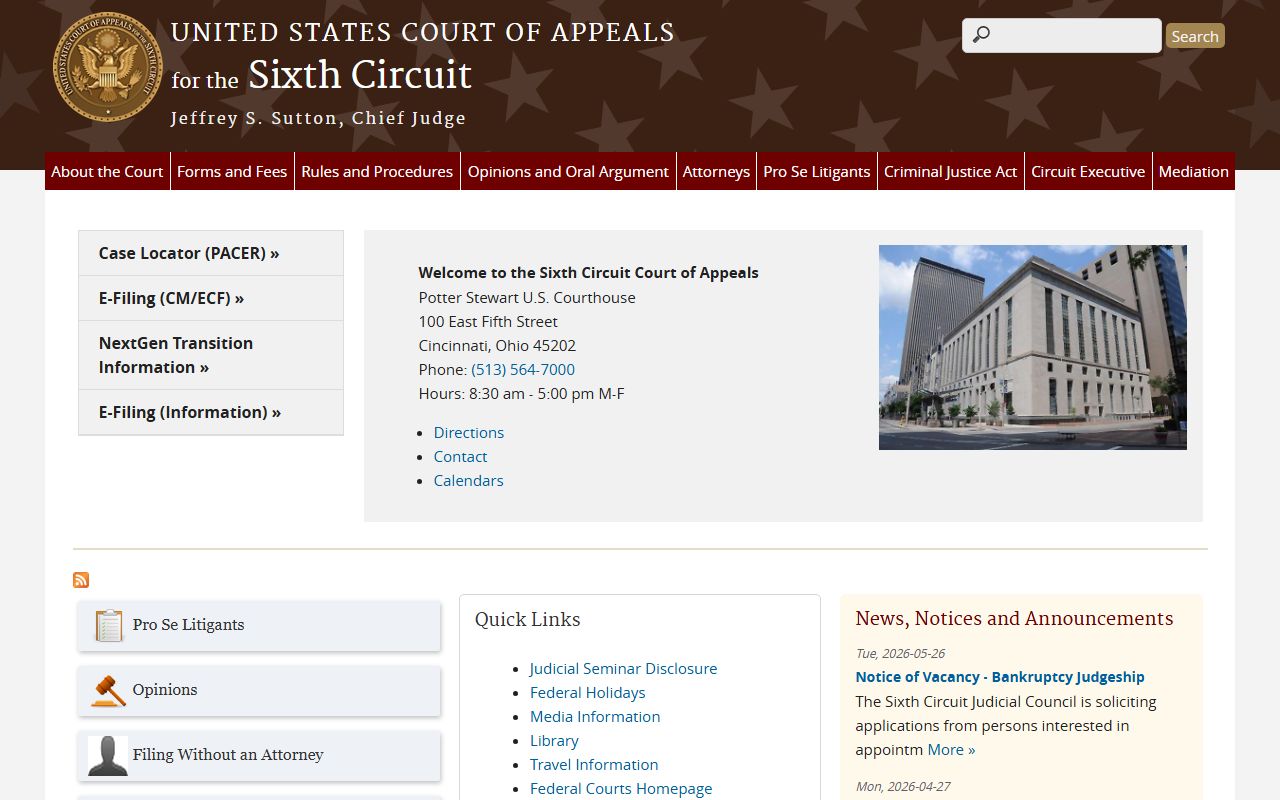
After the Sixth Circuit, the only further appeal is to the U.S. Supreme Court on certiorari, which is a discretionary process the Court grants in a small fraction of cases.
Federal case records are accessed through PACER, the Public Access to Court Electronic Records system. PACER charges a per-page fee after quarterly thresholds are met; verify the current fee schedule before you sign up. Registered users can search by party name, case number, and other filters across federal courts nationwide.

PACER requires registration. Some users qualify for fee exemptions or quarterly fee waivers depending on usage; check the PACER fee schedule for current thresholds. To search across all federal courts at once, the PACER Case Locator is the national index.
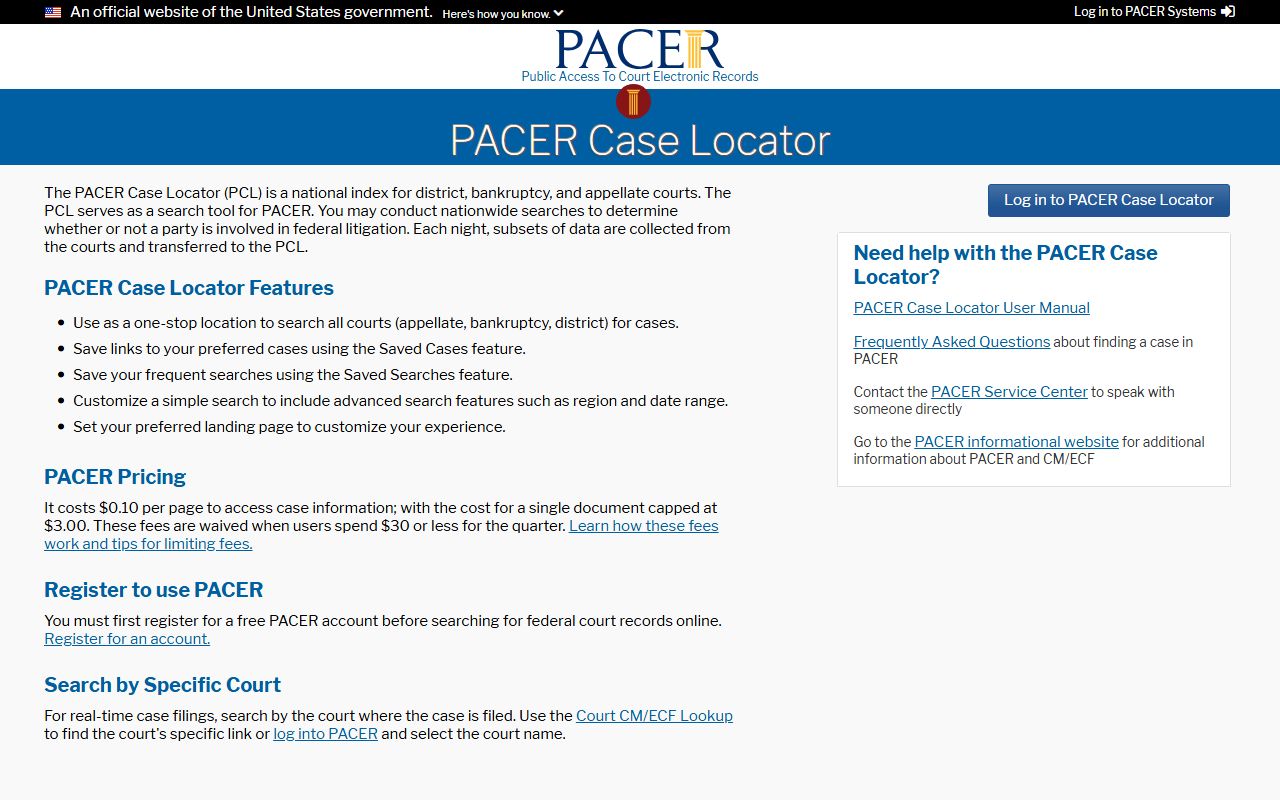
The Case Locator helps when you do not know which federal court holds a matter tied to Rutherford County.
For the Middle District of Tennessee specifically, the CM/ECF filing and case management system is at ecf.tnmd.uscourts.gov. Attorneys and registered filers use CM/ECF to file documents electronically, and PACER credentials are used to access the dockets and documents filed through CM/ECF.
CM/ECF is the electronic filing platform used by the Middle District; PACER is the read-only access layer. Both use the same login credentials once you register with PACER. A free alternative for federal opinions and some dockets is CourtListener, which does not charge per-page fees but may not have the most current filings.
District Attorney and Public Defender
The District Attorney General and Public Defender both serve the 16th Judicial District, which covers Rutherford and Cannon Counties. Their offices handle the prosecution and defense of criminal cases in Circuit and General Sessions Courts. Neither office handles civil matters or provides general legal advice to the public, but they are the key contacts for criminal case status questions when you cannot reach the clerk directly.
Jennings H. Jones, District Attorney General
320 West Main Street, Suite 100
Murfreesboro, TN 37130
Phone: (615) 898-8008
Fax: (615) 898-8039
tennesseeda.gov/district-16
Gerald L. Melton, District Public Defender
Elrod Building, 118 North Church Street
Murfreesboro, TN 37130
Phone: (615) 898-8020
Fax: (615) 898-8061
tndpdc.org/pd-profiles/district-16
The Public Defender's office provides representation to defendants who cannot afford private counsel. A defendant must tell the judge at arraignment that they want public defender representation and cannot pay for an attorney. The office begins working after arraignment and formal assignment. The DA's Murfreesboro Criminal Office at Suite 100 handles criminal prosecution for both counties. The Child Support division is located separately at 20 N. Public Square, 3rd Floor, Murfreesboro, TN 37130, reachable at (615) 898-8002.
Domestic violence assistance is available at (615) 896-7377. Legal Aid Society of Middle Tennessee and the Cumberlands at laet.org provides civil legal help to eligible residents. The Rutherford and Cannon County Bar Association maintains a local attorney directory for those seeking private counsel.
Appeals Path From Rutherford County Courts
Knowing the appeals path matters when a case does not end the way you expect or when you need to find records in an appellate court. The path depends on whether the case is civil or criminal and which court originally decided it.
- General Sessions to Circuit Court - Appeals from General Sessions go to Circuit Court for a de novo hearing. The case is heard fresh, not just reviewed for errors.
- Circuit Court civil to Court of Appeals - Civil appeals from Circuit Court go to the Tennessee Court of Appeals, an intermediate appellate court that reviews for legal error rather than hearing new facts.
- Circuit Court criminal to Court of Criminal Appeals - Criminal appeals from Circuit Court go to the Tennessee Court of Criminal Appeals, which reviews criminal matters separately from the civil appellate track.
- Court of Appeals or Court of Criminal Appeals to Tennessee Supreme Court - Further review is by the Tennessee Supreme Court, which has discretionary jurisdiction in most cases. The court accepts relatively few cases each year.
- State courts to federal courts - Federal review of state criminal convictions is possible through federal habeas corpus proceedings in the U.S. District Court for the Middle District of Tennessee, but this is a separate process with strict rules about exhausting state remedies first.
For Chancery Court civil appeals, the path is the same as Circuit Court civil: Tennessee Court of Appeals and then potentially the Tennessee Supreme Court. Probate appeals from the County Clerk/General Sessions Probate setting would also follow the civil appellate track. If you need records from a Tennessee appellate court, the Tennessee AOC maintains case information at tncourts.gov for the Supreme Court and intermediate appellate courts. Federal appellate records are accessible through PACER or CourtListener for Sixth Circuit decisions.
Judicial Center Contact Card
Most state court operations in the county are centered at the Rutherford County Judicial Center. The building opened in 2018 and houses Circuit Civil, Circuit Criminal, General Sessions Civil, General Sessions Criminal, the Juvenile Clerk, and Chancery Court in the same facility. Free parking is available at the garage at 233 North Maple Street, across from the Judicial Building. The building closes to the public at 4:15 p.m., so plan to arrive early if you need to reach a clerk counter.
116 W. Lytle St.
Murfreesboro, TN 37130
Circuit Civil: (615) 898-7820
Circuit Criminal: (615) 898-7812
General Sessions Civil: (615) 217-0069
General Sessions Criminal: (615) 898-7831
Juvenile Clerk: (615) 898-7972
Chancery / Clerk and Master: (615) 898-7860
Jury Duty: (615) 907-3566
Collections: (615) 849-5737
ADA Coordinator: (615) 494-4480
For online case searches covering Circuit Court, General Sessions, and Clerk and Master records, use the free portal at rutherford.tncrtinfo.com. For full case file copies or certified documents, contact the specific clerk division for the court where the case was filed. The Circuit Court Clerk page has more detail on how to request records and what to expect when you visit the Judicial Center.