
How to Request Rutherford County Public Records
Most Rutherford County public records can be reached by going directly to the office that keeps them. The right office depends on the type of record. Court filings go through the Circuit Court Clerk or Chancery Clerk and Master. Sheriff reports and incident records go through the Sheriff's Warrants and Records Division. County administrative records go through the County Clerk. Start by figuring out which office owns the record you need, then follow the steps for that office.
- Identify the right custodian. Decide whether the record is a court filing, a sheriff report, a county license, a commission minute, or another type. Match it to the office: Circuit Court Clerk (116 W. Lytle St., Room 102), Chancery Clerk and Master (116 W. Lytle St., Suite 5101), County Clerk (319 N. Maple St., Suite 121), or Sheriff's Warrants and Records Division.
- Download or pick up a request form. The Circuit Court Clerk's open records request form is available on the Circuit Forms page at rutherfordcountytn.gov/circuit-forms. The Sheriff's Office form is linked from rcsotn.com/warrants-division and can also be emailed to recordsrequest@rcsotn.org.
- Fill out the form completely. Include your name, contact information, and a clear description of the records you want. The Tennessee Public Records Act does not require you to give a reason, but your request must describe existing records well enough for the office to find them. You cannot use a request to force an office to create a new record or compile data it does not already hold.
- State whether you want inspection or copies. Inspection is generally free. If you want paper or electronic copies, copy charges will apply under the Schedule of Reasonable Charges. Ask about the charge before you commit to a large copy order.
- Submit the form. Hand it to the clerk's counter, mail it to the office address, or email it if the office accepts email requests. The Sheriff's Office accepts emailed requests for incident reports at recordsrequest@rcsotn.org. The Sheriff's form states that requests will be replied to within 7 business days.
- Pay any fees and receive the records. Outstanding court costs must be cleared before Chancery will release copies. For the County Clerk, cash, in-state checks, and debit or credit cards are accepted; a convenience fee of 2.25 percent plus $0.25 applies to card transactions.
- If your request is denied, ask for the reason in writing. Under the Tennessee Public Records Act, a denial should come with an explanation. You can seek guidance from the Tennessee Office of Open Records Counsel or challenge the denial in court.
You do not have to hire a lawyer to request records. But if an agency refuses access and you believe the records are public, legal help can be useful. The Legal Aid Society of Middle Tennessee and the Cumberlands provides civil legal aid in the region.
The Tennessee Public Records Act
Tennessee's foundational public-records law is Tenn. Code Ann. section 10-7-503. It states that all state, county, and municipal records are open for personal inspection by any Tennessee citizen unless another statute, court rule, or court order says otherwise. The default position is openness. An agency cannot simply decide to keep a record secret; it needs a specific legal basis.
The statute defines the term records custodian and places duties on government entities. One of those duties is to establish and maintain a written public-records policy. That written policy must explain how the entity handles requests, what forms it uses, and what to do if access is denied. Rutherford County offices keep these policies on file. If you are unsure how a particular office handles requests, you can ask to see its written policy.
The law also addresses how custodians must respond. They must be prompt. If a requested record is not immediately available, the custodian should tell you why and give a time frame. The custodian cannot charge you to inspect records unless another law specifically requires it. Charges come into play when you want copies rather than inspection.
Tennessee's citizen-access rule matters. The TPRA expressly opens records to Tennessee citizens. Non-residents may have access in some circumstances, but the core statutory right belongs to state citizens. In practice, most Rutherford County offices do not demand proof of residency for routine requests, but the requirement exists in the law and can matter in contested situations.
The Tennessee Office of Open Records Counsel FAQ is the best plain-language guide to how the TPRA works in practice. It covers what counts as a public record, how quickly custodians must respond, what fees are permitted, and how to handle a denial. The Open Records Counsel does not have enforcement power but provides guidance and is a useful first stop when a request hits trouble.
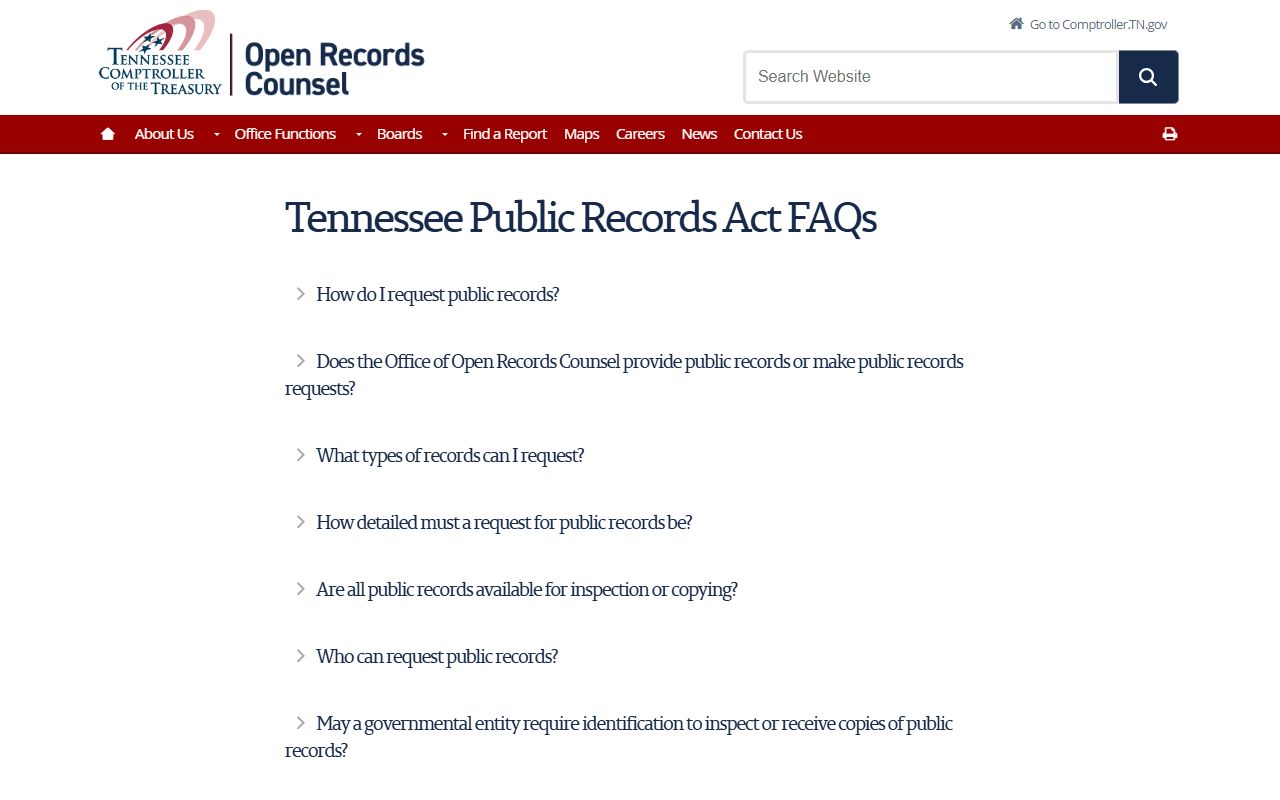
The FAQ spells out that a custodian cannot charge for inspection of public records unless a charge is otherwise required by law. Copy costs are a separate matter and are governed by the Schedule of Reasonable Charges adopted under state authority.
Tennessee Supreme Court Rule 34
Court records in Tennessee are covered by a separate authority: Tennessee Supreme Court Rule 34. This rule states that the public has a right to inspect court records unless the record is excepted by the Public Records Act, another state law, the rule itself, another court rule, or a court order. Rule 34 does not replace the TPRA. It works alongside it and adds court-specific detail about what a court record is and how clerks manage access.
Under Rule 34, court records fall into three categories: case records, administrative records, and judicial records. Case records are the filings, orders, exhibits, and docket entries tied to an individual case. Administrative records are the records a court generates to run its operations. Judicial records are documents created by a judge in the exercise of judicial functions. All three types are presumptively public, but the rule allows reasonable requirements to preserve record integrity and to ensure courts can keep operating efficiently.
Rule 34 also permits courts to restrict access to portions of a record that contain confidential information even when the rest of the file is public. This is why you may see a case file with certain exhibits or attachments listed as sealed or restricted. The clerk will tell you if a document is restricted; the clerk cannot waive the restriction. Only a court order can lift a seal placed by another court order.
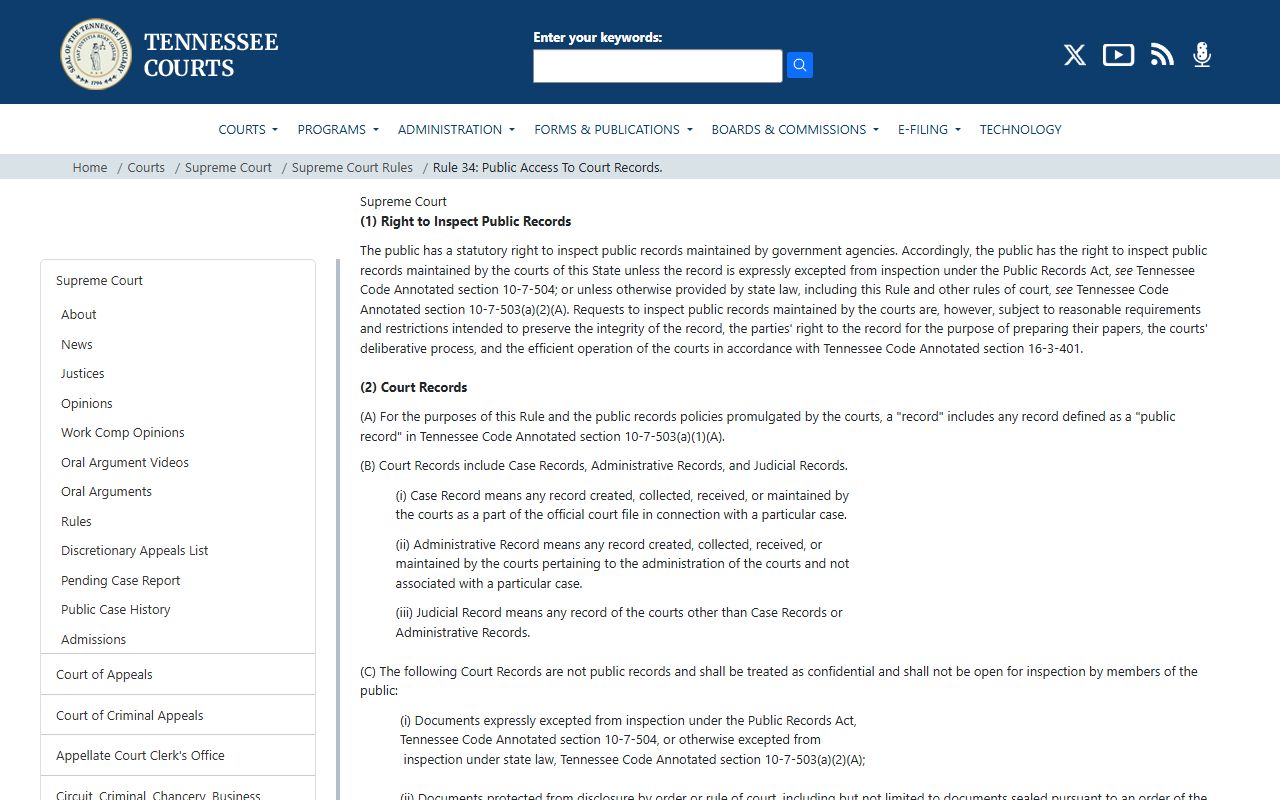
Rule 34 is the reason clerks in Rutherford County can impose reasonable conditions on how you inspect records, such as requiring you to view them at the counter rather than taking loose documents out of the office. That kind of requirement preserves the record without blocking access, which is exactly what the rule allows.
Court Records vs Sheriff's Records vs County Records
Three main offices produce most of the public records people search in Rutherford County. Knowing which one has what you need cuts down on wasted trips and wrong-office requests.
| Office | Clerk / Official | Records Held |
|---|---|---|
| Circuit Court Clerk | Melissa Harrell | Circuit Civil, Circuit Criminal, General Sessions Civil, General Sessions Criminal, Juvenile clerk functions; case filings, dockets, orders, judgments, bonds, probation orders |
| Chancery Clerk and Master | Adam T. Dodd | Divorce, adoption, paternity, orders of protection, conservatorships, guardianships, name changes, probate-related matters, real estate Chancery cases, foreign judgments, trust matters |
| County Clerk | Lisa Duke Crowell | Marriage licenses, business licenses, beer permits, vehicle registrations, notary commissions, county commission minutes, Beer Board records, probate filings, wills, conservatorship and guardianship filings |
| Sheriff's Warrants and Records Division | Rutherford County Sheriff's Office | Incident reports, background check requests, gun permit local checks, traffic crash report requests, public records requests for Sheriff's Office records |
Some records overlap. Probate, for example, touches both the County Clerk (who receives probate filings and keeps wills) and the Chancery Clerk and Master (who handles Chancery-level probate matters). A court record that began in General Sessions but was appealed to Circuit will have entries under the Circuit Court Clerk. When in doubt, call the office that seems most likely and ask; clerks can usually direct you to the right place even if they do not hold the record themselves.
Public Records Request Forms
Two offices in Rutherford County publish formal public-records request forms: the Circuit Court Clerk and the Sheriff's Office. Using the right form ensures your request meets the legal description standard and triggers the agency's response obligations under the TPRA.
The Circuit Court Clerk's open records request form is available through the forms page at rutherfordcountytn.gov/circuit-forms. The Sheriff's Office public records request form is linked from rcsotn.com/warrants-division, and emailed requests for incident reports can go to recordsrequest@rcsotn.org. The Sheriff's form states that requests will be replied to within 7 business days.
Statewide court forms and publications are gathered on the Tennessee Courts forms page, which is useful when a matter crosses county lines.
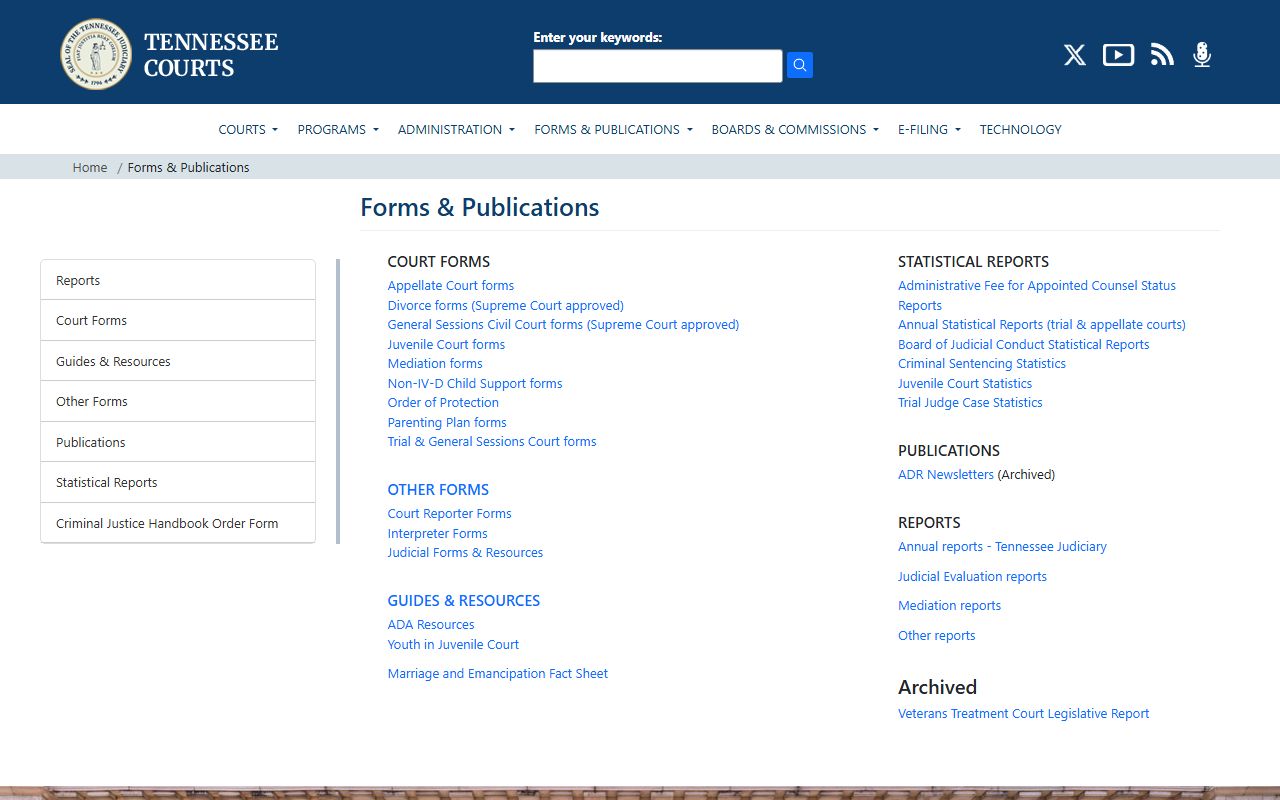
Those state forms supplement, but do not replace, the local request forms each Rutherford County office uses. The table below shows the fields found on these forms, based on research of each office's publicly available form and Tennessee's written-policy requirements.
| Field Label | Office | Type | Notes |
|---|---|---|---|
| Requestor name | Circuit Court Clerk; Sheriff | Text | Identifies the person making the request |
| Contact information | Circuit Court Clerk; Sheriff | Text | Email, mailing address, or phone for response |
| Address / phone / email | Sheriff | Text | Used for Tennessee citizen verification and delivery |
| Records requested | Circuit Court Clerk; Sheriff | Text / memo | Must describe existing records; TPRA does not require creation of new records |
| Inspection or copy preference | Circuit Court Clerk; Sheriff | Checkbox / text | Inspection is generally free; copies subject to the Schedule of Reasonable Charges |
| Delivery method | Circuit Court Clerk | Checkbox / text | In person, mail, email, or other method depending on record type |
| Signature / verification | Circuit Court Clerk; Sheriff | Signature | Sheriff form: requestor verifies awareness of state law; supports Tennessee-citizen requirement |
For the Chancery Clerk and Master, copy requests by mail should include the case number, style of case, return mailing address, and a daytime phone number. Send those requests to Chancery Court, 116 W. Lytle St., Suite 5101, Murfreesboro, TN 37130. The Circuit Court Clerk page and the County Clerk page have more detail on each office's procedures.
Inspection vs Copies of Public Records
Tennessee draws a clear line between inspecting a record and getting a copy of it. Inspection is the right to look at the original record at the custodian's office. Copies are physical or electronic reproductions you take with you. The TPRA says a custodian cannot charge you for inspection unless another law specifically requires it. Copy charges are different; those fall under the Schedule of Reasonable Charges.
In practice, inspection means going to the clerk's counter, requesting the file, and reviewing it there. You may take notes. Some offices allow you to photograph records with a personal device, but individual office policies vary. Ask before you start photographing. If an office does not allow personal photography, you will need to order copies through the clerk.
Certified copies are a step up from plain copies. A certified copy carries the court seal and the clerk's certification that it is a true and accurate reproduction of the original. Courts, agencies, and out-of-state institutions often require certified copies rather than plain photocopies. Chancery charges $5.00 plus $0.50 per page for a certified copy. The County Clerk charges $2.00 per page plus a $2.00 certification fee for certified probate copies. Plain photocopies at Chancery are $0.50 per page.
If you need records from multiple offices, plan separate trips or separate requests. Each office's copy schedule applies only to that office's records. The fax-filing service at Chancery, available to attorneys under local rules, has its own separate charge schedule and is not a route for public records requests.
Rutherford County Public Records Copy Fees
Copy charges in Rutherford County follow each office's local schedule, which must stay within the bounds set by state law. Inspection itself does not carry a charge. The table below summarizes the copy and certification fees documented for the main offices.
| Office / Record Type | Plain Copy | Certified Copy | Notes |
|---|---|---|---|
| Chancery Court (Clerk and Master) | $0.50 per page | $5.00 plus $0.50 per page | Outstanding costs must be cleared before copies are released; mail requests need case number, style, address, phone |
| County Clerk (probate records) | $0.50 per page | $2.00 per page plus $2.00 certification fee | Probate matters are public record and available for review in the County Clerk's office |
| Chancery (attorney fax copies) | $3.00 plus $0.50 per page | N/A | Attorney fax-copy service only; agreement to pay within 5 judicial days required |
| Inspection (all offices) | No charge | N/A | TPRA prohibits charging for inspection unless another law requires it |
The County Clerk accepts cash, Tennessee-bank checks (payable to Rutherford County Clerk, phone number required), and debit or credit cards. Cards carry a convenience fee of 2.25 percent plus $0.25, collected by a third-party processor. Rutherford County does not receive any part of that fee. Call the specific office before a large copy order to confirm the current charge schedule, since fees can be updated by local rule or court order.
Confidential Records in Rutherford County
Not all county records are open. Tennessee law carves out a range of categories that are confidential by statute, court rule, or court order. The main statute for confidentiality exceptions is Tenn. Code Ann. section 10-7-504, which lists the types of records that state law makes confidential despite the general openness rule. Tennessee Supreme Court Rule 34 expressly incorporates these Public Records Act exceptions for court records.
Juvenile records are a major restricted category. Under Tenn. Code Ann. section 37-1-153, juvenile court files and records are generally confidential. Access is limited to the parties, their attorneys, agencies with a statutory role, and persons authorized by court order or statute. Intentional public disclosure of juvenile records is an offense under that statute. If a case involves a juvenile, public records requests for those files will be denied or heavily redacted.
Adoption records are also confidential under Tennessee adoption statutes. Chancery Court handles adoption filings, but those files are not treated as ordinary public civil records. Only persons with statutory authority or a court order can access full adoption files.
Sealed records are a third category. A sealed record may still exist in the clerk's system, but access requires a court order to lift the seal. The clerk cannot grant you access to a sealed record on request; only a judge can do that. Sealing is not the same as expungement, which actually destroys or removes the record from public access.
Expunged records are removed or destroyed from public access under Tenn. Code Ann. section 40-32-101. After a valid expungement order, the clerk removes the record from the public portal. The expungement order is sent to the arresting agency, the county jail, the Tennessee Department of Correction, and the Tennessee Bureau of Investigation, so removal happens across systems. Expungement does not guarantee removal from private databases, news archives, or records that were lawfully published before the order was entered.
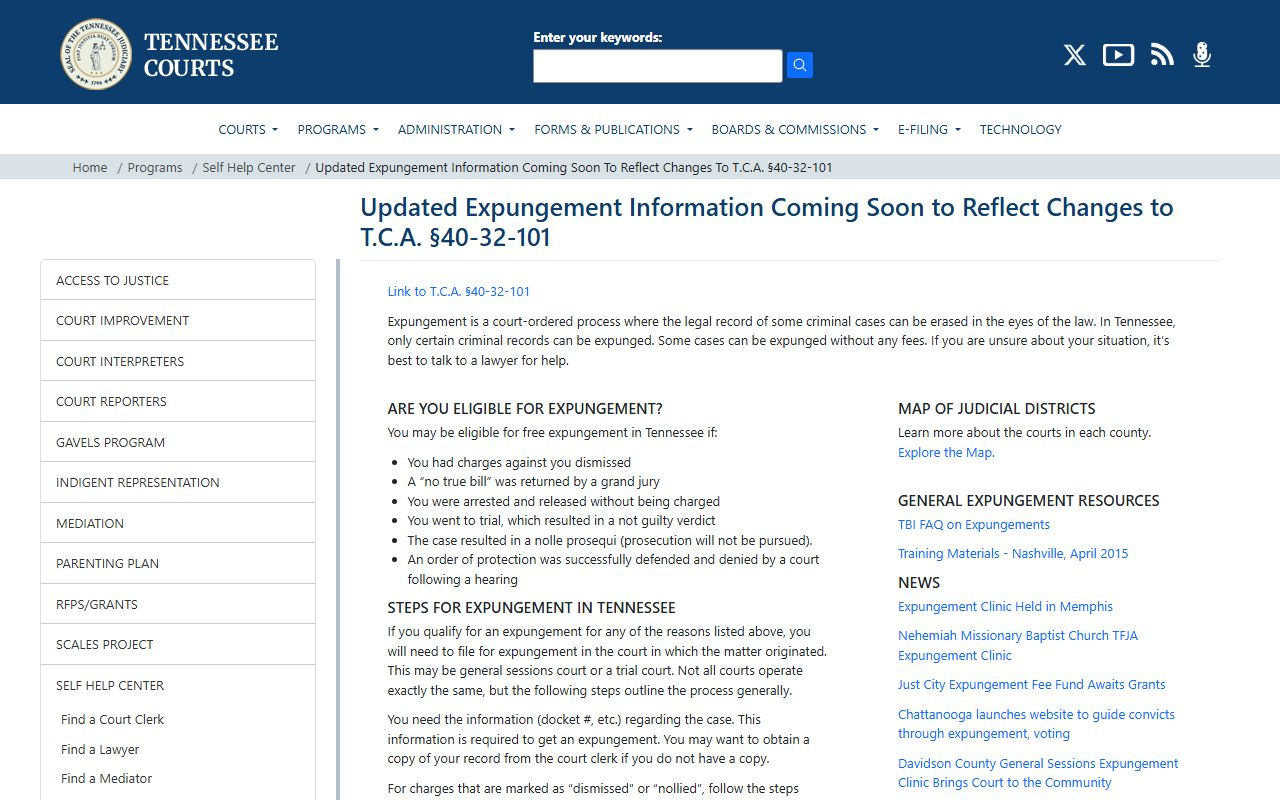
The Tennessee AOC expungement page explains the process and eligibility in plain terms. Starting in the court where the case was handled is the right first step for Rutherford County criminal matters. For Circuit and General Sessions cases, that means the Circuit Court Clerk at 116 W. Lytle St.
Other restricted categories include mental health and substance-use treatment records (protected by both state and federal law), grand jury proceedings (not public while under a secrecy rule), records with personal identifiers such as Social Security numbers and financial account numbers (routinely redacted), domestic violence victim information and addresses (restricted in protective-order cases), and ongoing law enforcement investigative records (withheld under TPRA exceptions until the investigation closes). Medical records included in court files may also be sealed or redacted under applicable state and federal law depending on the type of treatment involved.
Denials and Review of Public Records Requests
If a Rutherford County office denies your public records request, you have options. Under the Tennessee Public Records Act, a denial must come with an explanation of the legal basis for withholding the record. A blanket refusal without a reason is not a proper denial under state law. Ask for the denial in writing and ask the custodian to identify the specific statute or court rule being relied on.
The first place to turn for guidance is the Tennessee Office of Open Records Counsel. The Open Records Counsel provides free advice to the public and to government entities on how the TPRA applies. The Office does not have enforcement authority, meaning it cannot order an agency to release records, but it can issue formal opinions and informal guidance that sometimes resolve disputes without court action. The Open Records Counsel FAQ at the Comptroller's website is available at comptroller.tn.gov.
If guidance from the Open Records Counsel does not resolve the issue, the enforcement mechanism under the TPRA is court review. A Tennessee citizen can file a petition in the appropriate court to challenge a denial. Courts can order disclosure, assess costs, and in some cases award attorney's fees if a denial was not made in good faith. Legal aid resources such as the Legal Aid Society of Middle Tennessee and the Cumberlands and the Rutherford and Cannon County Bar Association can help connect requestors with attorneys who handle open-records disputes. See the FAQ page for common questions about record access and denials.
Note: A denial without a stated legal basis is not a valid denial under the TPRA. Request the reason in writing before deciding whether to escalate.
Records Custodians and Response Times
Each public office in Rutherford County acts as the records custodian for the records it generates and keeps. The custodian is the person or office legally responsible for managing those records and responding to inspection requests. Knowing who that is helps you direct your request to the right place and follow up if a response is slow.
116 W. Lytle St., Room 102
Murfreesboro, TN 37130
Circuit Civil: (615) 898-7820
Circuit Criminal: (615) 898-7812
General Sessions Civil: (615) 217-0069
General Sessions Criminal: (615) 898-7831
Juvenile Clerk: (615) 898-7972
116 W. Lytle St., Suite 5101
Murfreesboro, TN 37130
General / case information: (615) 898-7860
Docketing: (615) 217-0063
Mon-Fri 8:00 a.m.-4:30 p.m.
(Building closes to public at 4:15 p.m.)
319 N. Maple St., Suite 121
Murfreesboro, TN 37130
Phone: (615) 898-7800
Mon-Thu 8 a.m.-4 p.m.; Fri 8 a.m.-5 p.m.
Additional offices in Blackman, Smyrna, and Eagleville
Rutherford County Sheriff's Office
recordsrequest@rcsotn.org
Response: within 7 business days per Sheriff's form
rcsotn.com/warrants-division
The TPRA requires custodians to respond promptly. Tennessee courts have interpreted this to mean without unreasonable delay, though the statute does not set a fixed number of days for most records. The Sheriff's Office form commits to a 7-business-day reply. If you have not heard back within a reasonable time, follow up in writing and keep a copy. Delays that stretch into weeks without explanation may support a request for Open Records Counsel guidance or a court petition.
For criminal records, the free online case search at rutherford.tncrtinfo.com handles many basic inquiries without a formal request. The portal replaced the old subscription-login system on July 1, 2025, and is now free for all users. See the court records page for search tips and the Circuit Court Clerk page for more on clerk functions and fees.