
How to Find Rutherford County Arrest Records
Booking and arrest information in Rutherford County is held by the Rutherford County Sheriff's Office and Adult Detention Center at 940 New Salem Highway, not by the Circuit Court Clerk. The Sheriff's Office keeps booking records, incident reports, and custody data. The court portal at rutherford.tncrtinfo.com has criminal case histories once charges are filed in General Sessions or Circuit Court, but raw booking data and current custody status are separate from that system.
No county-hosted public inmate roster was found on the Sheriff's official site during research. The Adult Detention page links to a vendor-based visitation system rather than a searchable public roster. To confirm whether someone is in custody right now, call the Sheriff's Office and Adult Detention Center directly at (615) 898-7777. Staff can confirm if a person is held at the facility. For deeper inmate search options, the Rutherford County inmate records page covers the full custody verification process.
Incident reports can be requested through the Sheriff's Warrants and Records Division. Submit the public records request form found at the Sheriff's Office page, or email recordsrequest@rcsotn.org. The Tennessee Public Records Act, Tenn. Code Ann. section 10-7-503, generally requires government records to be open for inspection, but ongoing investigative records may be withheld until the investigation closes.
The Adult Detention Center page at rcsotn.com shows facility programs, visitation services, and contact details. It is the official starting point for arrest and custody questions about the Rutherford County jail.

The Adult Detention page confirms capacity, programs, and lobby hours for in-person visits to the Sheriff's Office. Always call ahead before traveling to the facility to confirm the service you need is available in person.
Rutherford County Sheriff and the Adult Detention Center
Sheriff Mike Fitzhugh leads the Rutherford County Sheriff's Office. The Sheriff's Office operates the Adult Detention Center and handles bookings for the county. The facility sits at 940 New Salem Highway, Murfreesboro, Tennessee 37129, which is separate from the Judicial Center on West Lytle Street where court clerks operate.
Sheriff Mike Fitzhugh
940 New Salem Highway
Murfreesboro, TN 37129
Phone: (615) 898-7777
Emergency: 911
Lobby Hours: 8:00 a.m. to 10:00 p.m.
Community Engagement Unit: (615) 904-3019
Narcotics: (615) 895-3609
The Adult Detention Center holds up to 956 people. It houses both pretrial detainees who have not yet been convicted and sentenced prisoners serving time. Men and women are held in a double-cell setup. The facility handles people from arrest through the booking process and can house sentenced inmates for up to eight years on state offenses.
Programs at the detention center include HiSet and GED preparation, Alcoholics Anonymous, life skills classes, parenting courses, Bible studies, church services, and the Reformers Unanimous program. Nonviolent inmates with lesser charges may serve as trusties, doing work such as cleaning, mowing, and grounds maintenance. State law allows trusties to earn one day off their sentence for each day of labor. The facility also provides medical services, a library, and legal materials for inmates who need them.
The Sheriff's Office does not provide fingerprinting services to the public. Background check services and employment screening go through separate channels, discussed further below in the background checks section.
The Booking and Arrest Process
When someone is arrested in Rutherford County, they go through an intake process before they join the jail population. The arresting agency can be the Sheriff's Office, a city police department, the Tennessee Highway Patrol, or another law enforcement body. All of them bring arrestees to the Adult Detention Center for processing.
The typical steps in the booking process are:
- Arrest by a law enforcement officer and transport to the Adult Detention Center.
- Identity check and property inventory at intake.
- Booking photo and fingerprints.
- Medical and mental health screening.
- Classification and housing assignment.
- Entry of charging documents, warrant or citation details, and bond conditions.
- First appearance or General Sessions event scheduled as required by Tennessee law.
Once a person is processed, they get access to phone services, attorney contact, medical care, legal materials, visitation scheduling, and commissary. Phone service is run by ICSolutions. Families can set up prepaid or debit calling accounts at icsolutions.com or by calling 1-888-506-8407. Commissary deposits go through jailfunds.com or kiosks at the facility. Video visitation is handled through VendEngine and TBE at tbejail.com.
What happens after booking depends on the charges. Some people bond out quickly. Others wait in custody for a court date. Bond amounts and conditions are set by a judicial commissioner or judge at first appearance. Active warrants related to criminal cases are covered on the warrant records page.
Arrest Record vs Criminal Court Record
People often mix up an arrest record with a criminal court record. They cover related but different events, and they are stored in different places. An arrest record reflects what happened at the time of booking. A criminal court record reflects what happened in the courtroom after charges were filed.
| Feature | Arrest Record | Criminal Court Record |
|---|---|---|
| What it shows | Booking date, charges at arrest, bond, custody status | Case filings, hearings, pleas, judgment, sentencing |
| Who holds it | Sheriff's Office / Adult Detention Center | Circuit Court Clerk (Melissa Harrell) |
| Where to search | Call (615) 898-7777; request via recordsrequest@rcsotn.org | rutherford.tncrtinfo.com or in person at the clerk's office |
| Reflects outcome? | No; an arrest is not a conviction | Yes; shows disposition, plea, or verdict |
| Public access | Incident reports available by public records request | Case search free online; certified copies available for a fee |
For full criminal court history, use the online case portal or visit the Circuit Court Clerk at 116 W. Lytle St., Room 102, Murfreesboro. The Rutherford County court records page covers how to use the case search and how to get certified copies from the clerk.
Charges vs Convictions
An arrest leads to charges, but charges are not convictions. This matters when you read any arrest record or criminal case file. The legal system treats a charge as an allegation until a court resolves it. Knowing the difference protects both the person searching and the person whose record is being reviewed.
| Term | What It Means | Effect on Record |
|---|---|---|
| Charge or indictment | A formal accusation filed by the state or grand jury | Appears in arrest and court records; not yet a finding of guilt |
| Nolle prosequi or dismissal | The state drops or the court dismisses the charge | Case closed; may be eligible for expungement under Tenn. Code Ann. section 40-32-101 |
| Acquittal | Not guilty finding by judge or jury | No conviction; eligible for expungement in most cases |
| Guilty plea or verdict | Court finds or defendant admits guilt | Conviction on record; sentence imposed; expungement eligibility is limited |
| Diversion | Defendant completes a program to avoid a conviction | If completed, eligible for expungement; if revoked, the case resumes |
Never assume an arrest means a person was convicted. Court records show the disposition, which is the final outcome. Check the disposition field in the case search before drawing any conclusion about guilt. If the disposition says dismissed, acquitted, or nolle pros, there is no conviction for that charge.
What a Rutherford County Arrest Record Shows
Booking records contain a standard set of fields. The exact layout depends on what the Sheriff's Office or arresting agency documents at intake. Based on standard Tennessee jail practice and the Adult Detention Center research, a booking record typically includes these data points.
| Field | Description |
|---|---|
| Full name | Legal name of the person booked |
| Booking number | Unique identifier assigned at intake |
| Booking date and time | When the person arrived at the facility |
| Date of birth and age | Used for identity verification |
| Race and sex | Physical descriptors recorded at booking |
| Height and weight | Physical identifiers from booking |
| Charges at arrest | Offenses noted when booked; may change as the case moves through court |
| Arresting agency | Which law enforcement body made the arrest |
| Bond amount and type | Cash, surety, or conditions set by judicial commissioner |
| Court date | Next scheduled appearance, if set at booking |
| Custody or release status | Whether the person is still held or has been released |
| Booking photo (mugshot) | Photograph taken at intake; public availability depends on whether the facility publishes a roster |
Not all of these fields are public in every case. Medical data, mental health screening results, protective-custody flags, and classification details are not ordinary public information. Sensitive identifiers such as Social Security numbers and financial account numbers are also kept out of public records under state law.
Background Checks and the TBI
The Rutherford County Sheriff's Office does not perform employment background checks for the public. That service is not offered at the Adult Detention Center or the Warrants and Records Division. For a Tennessee-only criminal background check, the Tennessee Bureau of Investigation is the state agency that handles it.
The TBI maintains the state criminal history database and runs background checks for employment, licensing, and other authorized purposes. The TBI website at tn.gov/tbi explains who may request a check and how to submit one. Employers and licensing boards typically use this channel for formal screening. The results reflect records in the TBI database, which is updated when courts and agencies report dispositions and when expungement orders are processed.
For incident reports from the Sheriff's Office, send a written public records request. The Sheriff's records request form is available on the Sheriff's Office site. You can also email the request to recordsrequest@rcsotn.org. The Warrants and Records Division page at rcsotn.com has details on the form and the process for traffic crash reports as well.
For Tennessee sex offender registry checks, the TBI runs a public registry at sor.tbi.tn.gov under Tenn. Code Ann. sections 40-39-201 et seq. Anyone can search by name without creating an account. The registry lists registered offenders and their reported addresses. The Tennessee Felony Offender Information Lookup, known as FOIL, is at foil.app.tn.gov/foil/search.jsp and lets the public search for people currently or previously in Tennessee Department of Correction custody.
Note: An incident report from the Sheriff's Office is not the same as a court case record. For case filings, court orders, and case dispositions, use the Rutherford County Online Court Records System or call the Circuit Court Clerk at (615) 898-7812 for criminal matters.
Sealed and Expunged Arrest Records
Tennessee law allows some arrest and criminal records to be removed from public access. The two main tools are sealing and expungement, and they work differently. Knowing the distinction matters if you are trying to clear a record or if you are researching someone and find that a case seems to be missing from the public system.
| Feature | Sealed Record | Expunged Record |
|---|---|---|
| What happens to the record | Restricted from public view; the record still exists | Destroyed or removed; ceases to exist as a public document |
| Who can still see it | Courts, law enforcement, and authorized agencies may keep access | Generally no public access; agencies are notified to remove it from their databases |
| Governing law | Court order or rule-based sealing in the original case | Tenn. Code Ann. section 40-32-101; a court order is required |
| Who qualifies | Determined by court order; varies by case and circumstances | Dismissed charges, acquittals, nolle prosequi, diversion completions, some eligible convictions |
| What it does not erase | Does not remove private records, news articles, or third-party copies | Does not remove lawfully published records or third-party data already collected |
The Tennessee AOC and TBI maintain an expungement FAQ at tncourts.gov/tbi-frequently-asked-questions-expungements. After a court grants expungement, the order goes to the arresting agency, the county jail, the Tennessee Department of Correction, and the TBI so each can update or remove its records.
The Tennessee expungement FAQ page at the Tennessee courts site explains eligibility and what steps to take after a case is resolved.
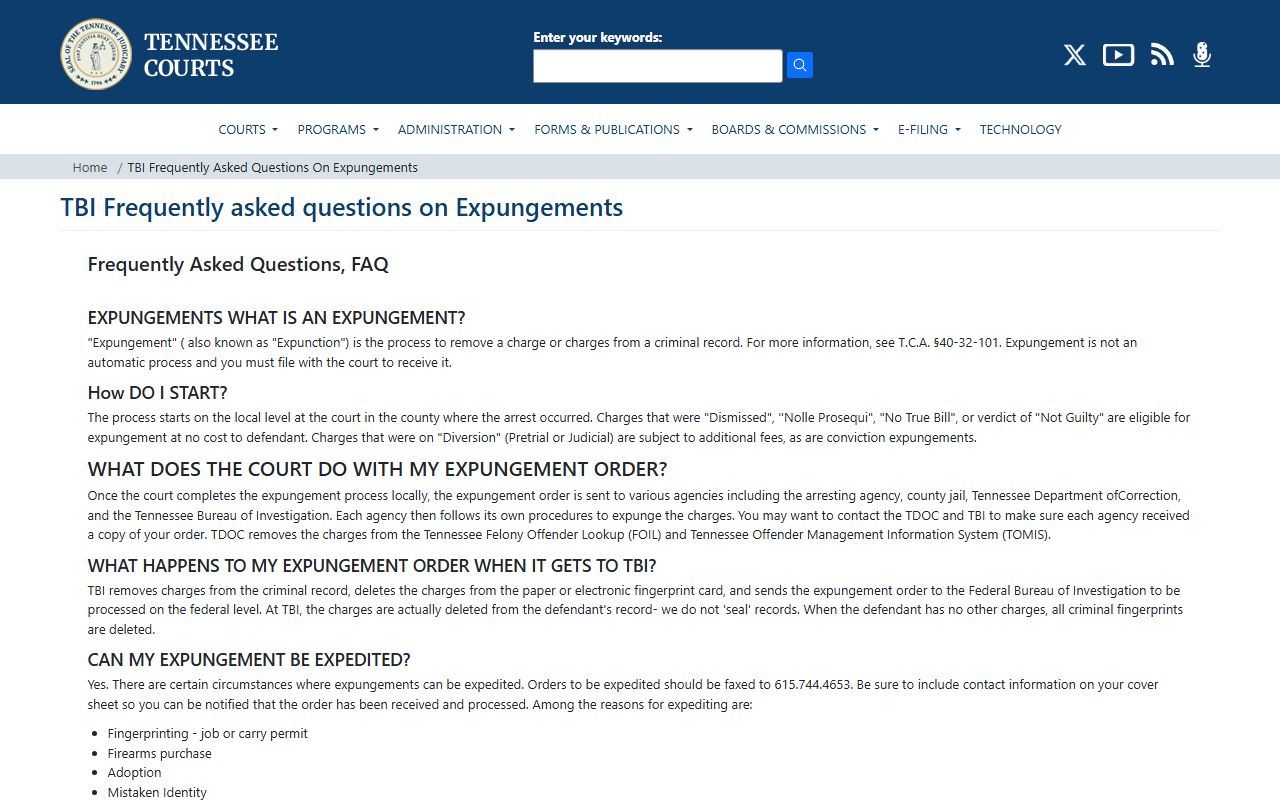
The FAQ outlines which agencies receive expungement orders and how the process flows from a local court order to statewide database updates across multiple state agencies.
To start an expungement in Rutherford County, file a petition at the court where the original case was handled. For Circuit Criminal or General Sessions Criminal matters, that means the Circuit Court Clerk at 116 W. Lytle St., Room 102. Clerks can accept the filing but cannot tell you if you qualify or advise you on strategy. Use an attorney when eligibility is uncertain. Common reasons expungement is denied include an ineligible offense type, unresolved fines or costs, too many prior convictions, or a pending case. For court records tied to the expungement process, visit the court records page.
Juvenile Criminal Confidentiality
Juvenile records in Tennessee are not treated like adult criminal records. They are restricted by state law and are not open to the general public. Tenn. Code Ann. section 37-1-153 makes juvenile court files and records confidential as a general rule. Access is limited to the parties, their attorneys, relevant government agencies, and persons authorized by statute or court order.
Intentional public disclosure of juvenile records when not permitted by law is itself a violation under that statute. Searching a public database or calling a clerk will not produce a minor's juvenile case in most situations. If you are a parent, guardian, or party in a juvenile matter, the juvenile clerk at (615) 898-7972 handles those files. The rules covering juvenile detention, charges, and hearings are separate from the adult criminal process.
When a juvenile is charged as an adult under a transfer or certification, the case may enter adult court and adult records systems. That is a judicial decision made in the specific case. It is not a general rule for all minors. If a juvenile matter was transferred to adult court, the resulting adult case may appear in the Circuit Criminal system and in the public online case portal at rutherford.tncrtinfo.com.
DA and Public Defender for the 16th District
Criminal cases in Rutherford County are prosecuted by the District Attorney General for the 16th Judicial District. Jennings H. Jones is the District Attorney General. He began his career in the DA's office in 1998, served as an Assistant District Attorney for 16 years, and has led the office since 2014. The 16th District covers Rutherford and Cannon Counties.
Jennings H. Jones, District Attorney General
320 West Main Street, Suite 100
Murfreesboro, TN 37130
Phone: (615) 898-8008
Fax: (615) 898-8039
Gerald L. Melton, Public Defender
The Elrod Building
118 North Church Street
Murfreesboro, TN 37130
Phone: (615) 898-8020
Fax: (615) 898-8061
Gerald L. Melton serves as the District Public Defender. He has held the position since his 1989 appointment by Governor Ned Ray McWherter and has been elected to the role multiple times since then. The Public Defender's office represents people who face criminal charges and cannot afford private counsel. A defendant must tell the judge at arraignment that they want public defender representation. The office begins working on a case after arraignment and formal court assignment.
The District 16 DA page at tennesseeda.gov has the official biography and contact information for Jennings H. Jones and the Murfreesboro criminal and child support offices.
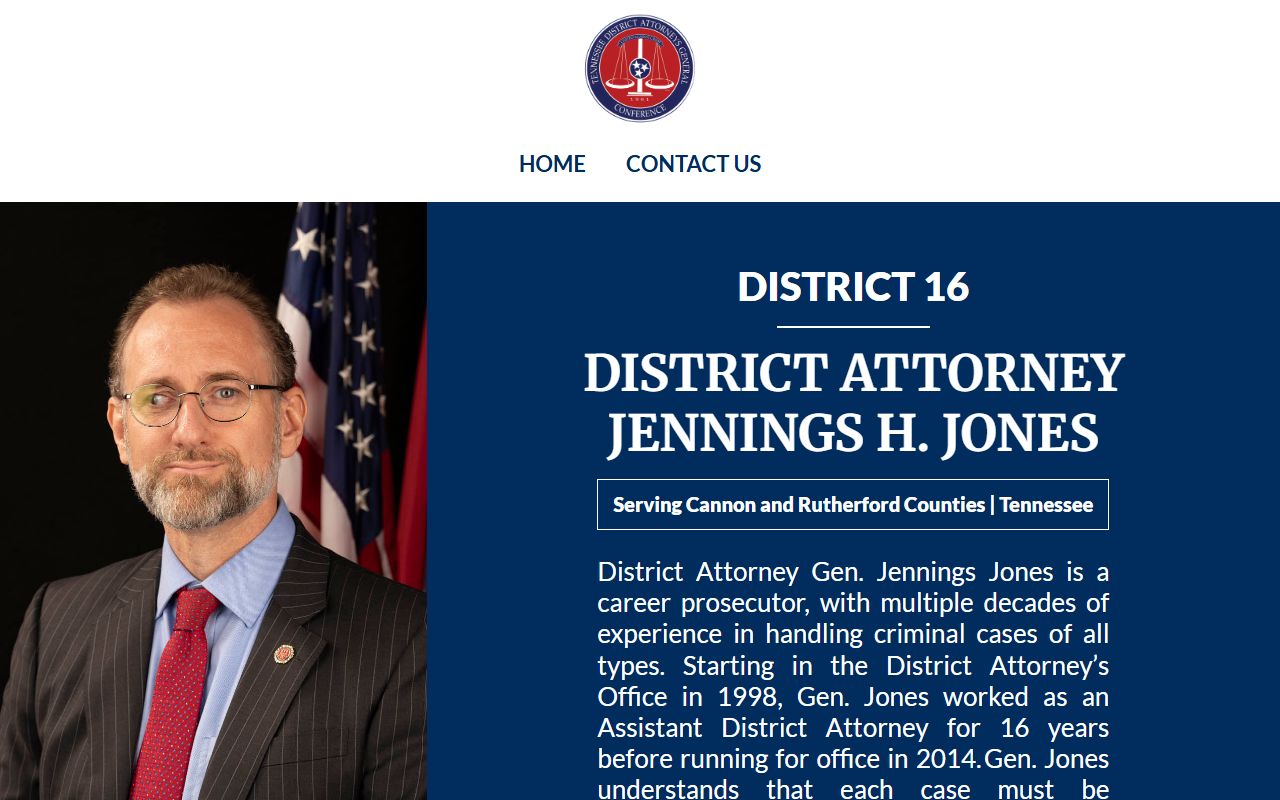
The District 16 page shows the DA's biography and the office contact details for both criminal prosecution and child support enforcement matters in Rutherford County.
For criminal cases tied to driving offenses, including DUI, the traffic court records page explains which courts hear those cases and how criminal charges intersect with traffic violations. DUI charges can move through General Sessions and then to Circuit Criminal for felony DUI cases. Active warrants related to criminal cases are covered on the warrant records page. If you need to find a private attorney, the Rutherford and Cannon County Bar Association maintains a directory at rccba.com. Legal Aid Society of Middle Tennessee and the Cumberlands at laet.org serves those who need civil legal help and cannot afford counsel.
The DA also has a child support office at 20 N. Public Square, 3rd Floor, Murfreesboro, TN 37130, phone (615) 898-8002. Child support enforcement is a civil matter but is handled through this office for the 16th District alongside criminal prosecution work.